
Dried flowers in a candle: beauty that burns at 180 °C
Morning light falls through the kitchen window, an espresso cup rests on a linen tablecloth, and next to it sits a cream-colored candle in a clay vessel. Pink buds protrude from the top, along with two pieces of cinnamon and a thin slice of dried orange. It looks like a photo any Instagram account would get a thousand likes on at eight o'clock on a Saturday morning. And that's precisely the problem. An hour after you strike the match, this candle turns into a small chemical lab test in your living room. What exactly happens, why it's not an aesthetic decision but a physical one, and where the line lies between a beautiful floral candle and a flower in flames? Let's break it down without panic and without exaggeration.
Pinterest photo vs. the physics of burning
When you search for "dried flower candle" or "botanical candle DIY" on Pinterest, you get thousands of images where a dried rose sticks out of the wax like a decoration on a wedding cake. The aesthetic of a rustic home, slow living, morning rituals. No one in those pictures is lighting the wick. The photos are static still lifes, and that's the whole misunderstanding. A dried flower looks its best before the first lighting. After the first burn, it no longer appears as the same object.
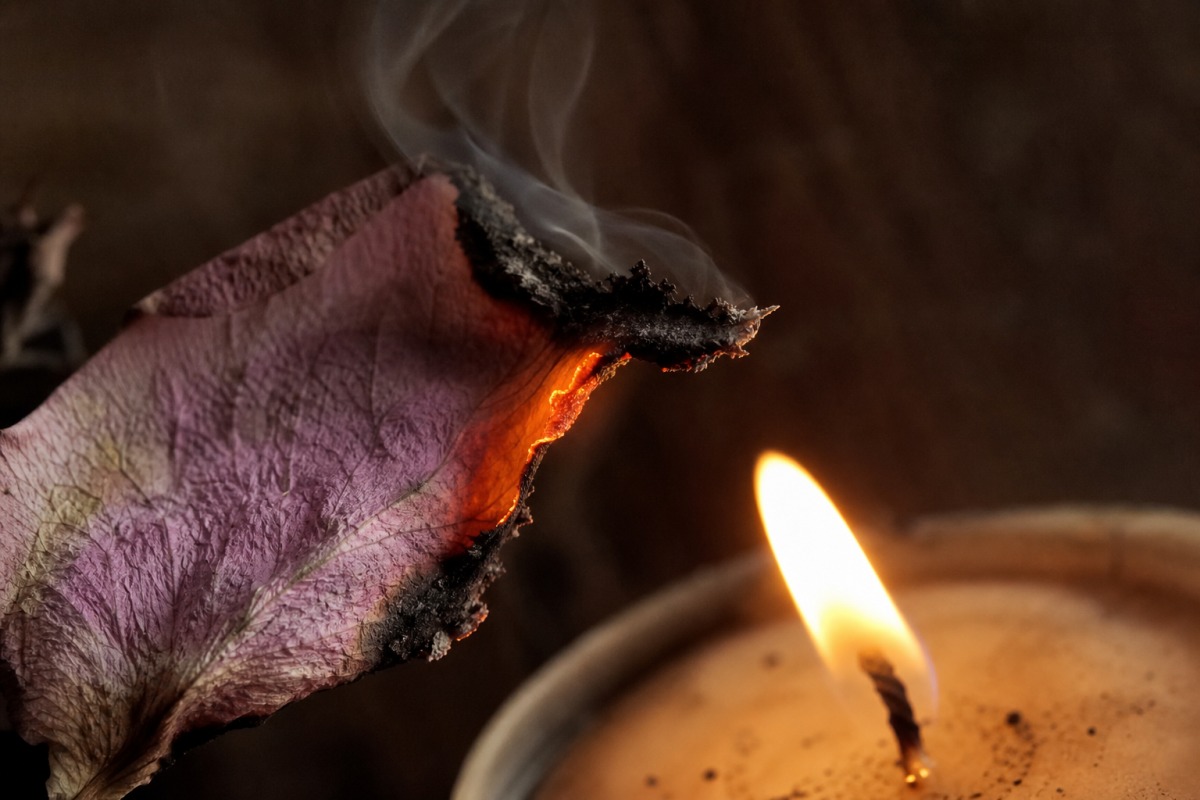
A dried rose or lavender stem has a residual moisture content of 5 to 10 percent. The rest is cellulose, lignin, and essential oils trapped within the cell walls. The flash point values of organic plant matter range between 180 and 250 °C, depending on density and oil content. The flame of a candle has a temperature of around 1300 to 1400 °C at its core and 600 to 800 °C at the edge of the luminous zone. The distance at which the flower catches fire depends on thickness, but practically, a direct proximity of 5 to 10 mm to the flame is enough for the edge of a petal to start burning within 8 to 12 seconds.
The aesthetic intention of the DIY creator is therefore at odds with the physics of the material being embedded in the wax. Soy wax melts at 50 to 60 °C, paraffin at 60 to 70 °C, while the flower is flammable at six times that temperature. Once the pool of melted wax spreads to the edge where the flower is embedded, it's only a matter of minutes before the flame gains a second source of fuel. The wax is fuel for the wick, not for the flower. The flower is fuel for itself.
Acrolein: what you breathe when cellulose burns
This is the part that most "natural candle" tutorials skip. When cellulose (dry plant matter) burns, a chemical compound called acrolein is formed, CAS number 107-02-8. It is a light yellow gas with a sharp, irritating odor. It is produced during the pyrolysis of plant material at temperatures of 250 to 350 °C, which is exactly what happens in the zone between the flame and the burning petal.
The International Agency for Research on Cancer (IARC) classifies acrolein as a Group 2A carcinogen, meaning "probably carcinogenic to humans" with long-term exposure. In acute doses, it strongly irritates the mucous membranes of the eyes, nose, and upper respiratory tract at concentrations as low as 0.1 ppm in the air. In a closed living room with a volume of 30 m³, burning just two or three dried petals is enough for the sharp odor to alert everyone in the room.
It's worth distinguishing. A single 15-minute episode of a burning flower in a well-ventilated room is unlikely to harm anyone. The risk arises with repeated exposure. If a candle with a flower is lit three times a week in a winter living room with tight windows, the cumulative dose of acrolein in the breathing space increases. Burning any solid organic matter indoors also raises the concentration of fine particulate matter PM2.5 (smaller than 2.5 micrometers, which penetrate deep into the lungs), which is why, when burning a candle with plant additives, it's advisable to ventilate the room and not let it burn in a tightly closed space.
The second complicating factor is the moisture content of the flowers. Commonly purchased dried roses have a residual moisture content of 5 to 7 percent, lavender 6 to 9 percent, hibiscus 8 to 10 percent. Upon contact with the flame, this water rapidly turns into steam, with a volume expansion of 1600 times. A moist flower petal literally bursts upon ignition: the steam erupts in a micro-explosion, carrying burning flower fragments a distance of 5 to 15 cm from their original position. In the enclosed space of a living room, this mechanism brings burning material onto the table, carpet, or curtain.
This isn't about panic. It's about being aware of what you are lighting.
Cinnamaldehyde: why cinnamon is a delicate ingredient
Back to the Pinterest scene. Two pieces of cinnamon stick out of the wax like natural decorations. It looks warm, Christmassy, cozy. Chemically, cinnamon is one of the most flammable plant materials in an average household.
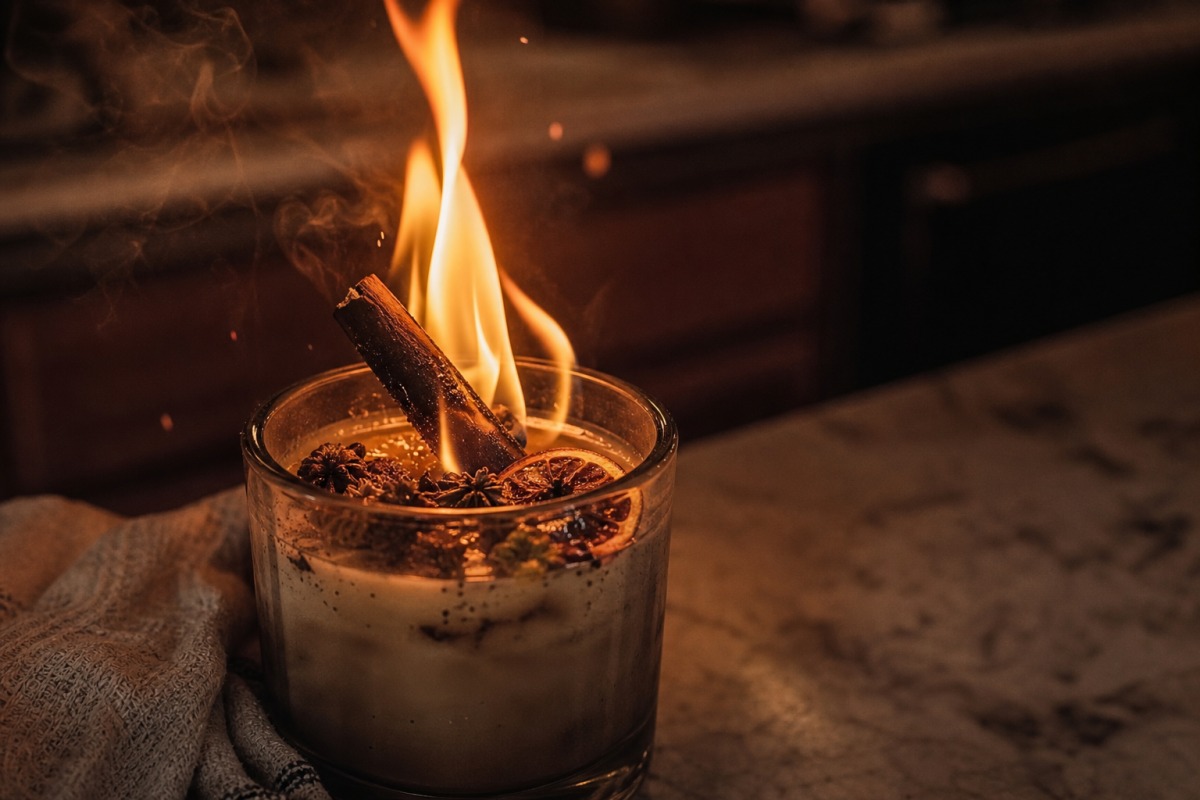
The main component of cinnamon essential oil is cinnamaldehyde, CAS number 104-55-2. Its flash point, according to safety data sheets, ranges approximately from 71 to 105 °C (depending on the measurement method and purity). For comparison: diesel fuel has a flash point around 55 to 65 °C. Cinnamaldehyde is therefore not more flammable than diesel; on the contrary, its flash point is slightly higher. The risk of cinnamon in a candle lies not in it being an extremely flammable liquid on its own, but in the combination of two factors: essential oils evaporate when heated, and these vapors can ignite violently upon direct contact with the flame, while the porous bark soaks up the wax and becomes additional fuel. A dried cinnamon stick contains 2 to 4 percent of this oil, and cinnamaldehyde makes up 65 to 90 percent of the content of cinnamon essential oil.
To understand the scale. Right at the start of burning, the surface of the wax heats up to 80 to 100 °C. A cinnamon stick 3 to 5 cm from the flame reaches a temperature of 100 to 130 °C, at which the essential oils in the bark begin to evaporate. A single direct contact of the evaporated oils with the flame, at the moment the wick flares up to a height of 5 cm, can cause a brief, intense flash. It's not as dramatic as in a movie; it's more of a sudden increase in flame intensity, sometimes with a brief sound effect (a soft pop or hiss). A second of inattention and the candle has a double-height flame.
This phenomenon is exactly the same one that causes cinnamon essential oil to be classified in IFRA standards as an item with a strict dosage limit (typically under 0.5 percent by weight for products intended for burning). A homemade DIY candle with a cinnamon stick directly on the surface exceeds this limit by three orders of magnitude.
The second factor is the porous structure of cinnamon bark. These capillaries absorb melted wax from the candle's surface, which penetrates the stick and becomes fuel. A stick with an original weight of 3 g absorbs 5 to 8 g of wax during prolonged contact. At the moment of ignition, it becomes a stronger source of combustion than the original candle: the flame reaches a height of 8 to 15 cm compared to 2 to 3 cm with a normal wick.
The same principle applies to dried rosemary, cloves, and star anise. Lemon and orange are less risky, but their dried peels contain highly flammable limonene compounds.
Table: flash point of common botanical additives
- Dried rose (petals): 200 to 220 °C, ignites in 8 to 12 seconds at a distance of 5 mm from the flame
- Dried lavender (spikes): 180 to 200 °C, ignites in 5 to 8 seconds, additionally absorbs wax
- Dried chamomile/tea petals: 190 to 210 °C, ignites in 7 to 10 seconds
- Dried citrus slice: 220 to 250 °C (higher density), ignites in 15 to 25 seconds, but burns for a long time
- Cinnamon stick: 200 to 230 °C surface, plus essential oils (cinnamaldehyde, flash point approximately 71 to 105 °C) evaporate when heated and the vapors can ignite violently upon contact with the flame; the bark also absorbs wax
- Dried apple slice: 210 to 240 °C, tannins migrate into the wax over 2 to 3 burns
- Hibiscus petals: 180 to 200 °C, intensely color the wax red-brown
For comparison: the average surface temperature of candle wax 3 cm from the wick is 80 to 110 °C. Direct contact of the flower with the flame or proximity within 5 mm means a surface temperature above 200 °C.
Wick submersion: how lavender drowns the wick
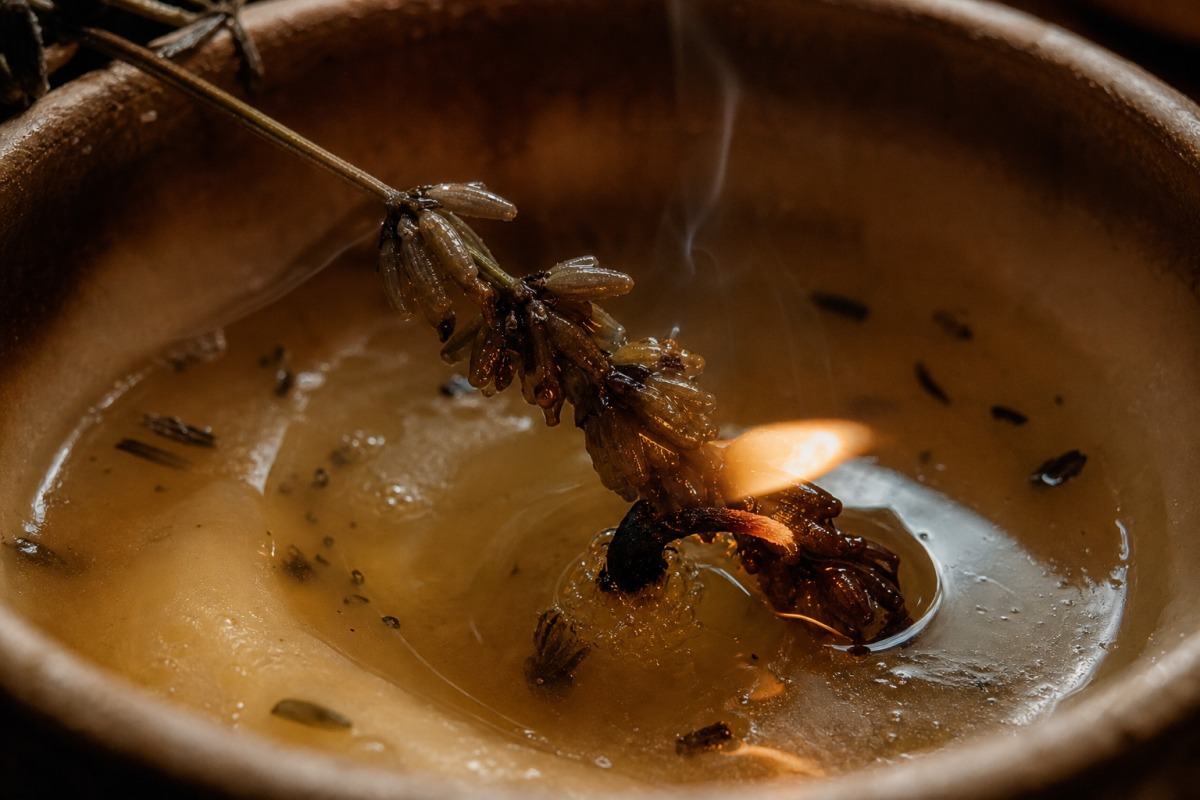
The second physical problem after ignition is quieter, but equally damaging. It is called wick submersion. This is no longer about the flower burning, but about its mechanical interaction with the melted wax.
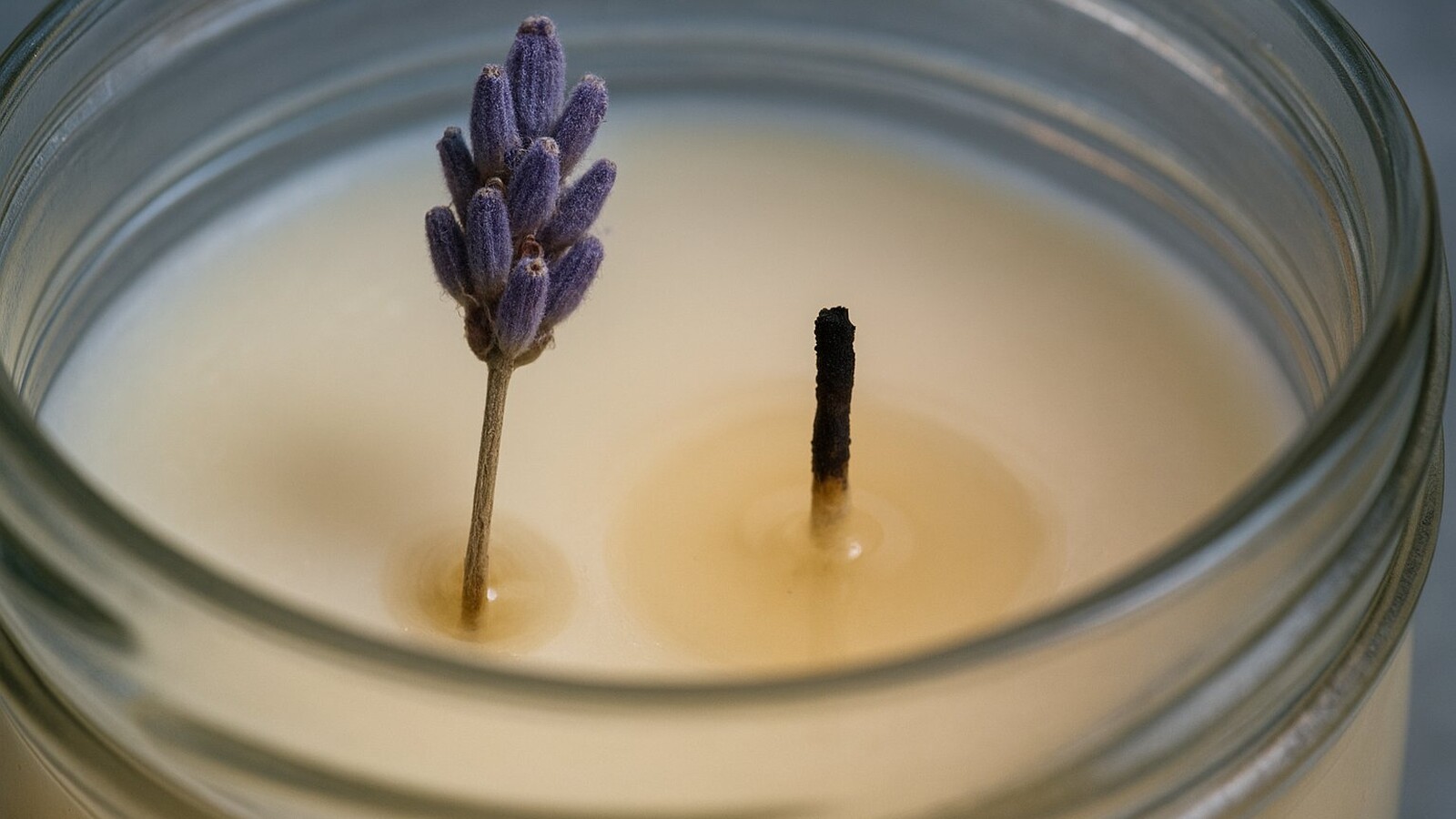
Dried plant material is highly absorbent. Dried lavender can absorb up to three times its own weight in melted wax. Dried rose absorbs slightly less (1.5 to 2 times), cinnamon less (0.5 to 1 time, because it is denser). A lavender spike with an original weight of 0.5 g absorbs 1 to 1.5 g of wax within 30 minutes of burning. This absorbed wax becomes unusable for capillary rise into the wick. The wax level around the wick drops unevenly, forming an asymmetric pool.
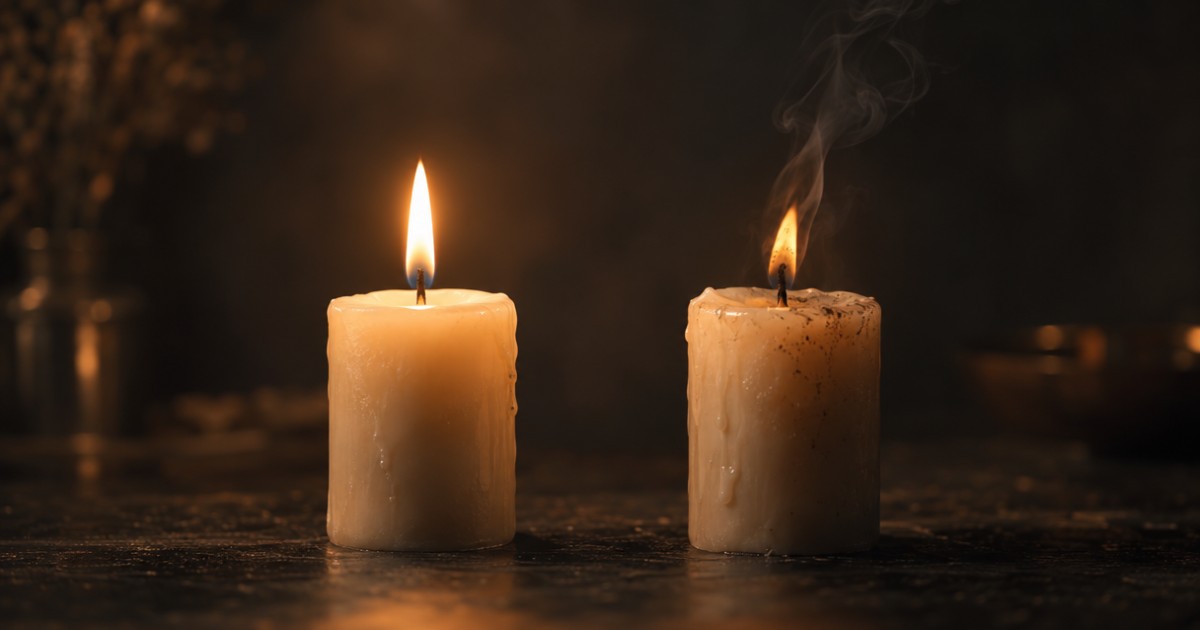
Once the plant in the pool of melted wax absorbs it, its weight increases and it loses its original shape. A rose petal curls up, turns yellow, and sinks to the bottom of the container. A lavender stem, which originally stood upright, tips over, often directly onto the wick. This creates an effect that English candle-making forums call a wet flag: the wick no longer absorbs pure wax, but wax plus residues of plant material and moisture. The flame weakens, begins to sputter, and produces soot. In some cases, the wick completely drowns in the pool and the candle goes out. In others (worse), the flame burns through to the edge of the soaked flower and the entire combustible mass ignites at once.
Four years ago, the botanical aesthetic from English blogs was put to the test. A candle with dried lavender in the top third went out after forty minutes; the wick had drowned. After relighting two days later (wick cleaned), after ten minutes the wax reached the second batch of lavender and the flame doubled in size. The candle ended up in a pot of sand. That is why flowers do not belong in wax.
Wick submersion reduces the candle's lifespan by 30 to 50 percent. A candle with a declared burn time of 40 hours will actually last 20 to 25. A wick that has gone out and been flooded with wax, when relit, produces multiple times the amount of smoke because the cold wax must first transition to a gaseous phase (incomplete combustion during the first 30 to 90 seconds). Emissions from incomplete combustion contain increased concentrations of acrolein and polycyclic aromatic hydrocarbons (PAHs), which are always produced during smoky, incomplete burning. In a closed, unventilated bedroom during repeated evening relighting, this burden accumulates and can be particularly unpleasant for sensitive individuals (children, asthmatics, people with COPD).
Color drift: wax loses its color after flowers
If the previous sections lead to the conclusion "OK, I'll be careful, I'll only leave the candle lit for a short time," there is still an aesthetic argument that might change your mind.
Natural soy wax has an off-white color, close to hex code #F5F0E1. It is a warm, creamy white with a slightly yellow undertone. However, after the first burn of a candle with a rose or hibiscus embedded in it, the color begins to change. This process is called color drift. Plant tannins and anthocyanins from the petals dissolve in the melted wax at 50 to 80 °C and, upon solidification, become part of its structure. After the second burn, the color shifts to a yellow-beige. After the third to fourth burn, it moves towards a brownish-yellow tone around #C9A876, which is the color of old, powdered cocoa.
This shift is not repairable. Wax molecules bound with tannins cannot be thermally separated. A candle that looked porcelain white when purchased will shift to a cocoa-brown color after three evenings of burning. Hibiscus and dried apple produce the strongest color drift. For comparison, pure soy wax maintains its light color throughout the entire burn time (10 to 50 hours) without any visual change.
Color drift also has a secondary impact on the scent. Tannins bind some of the fragrance molecules in the wax, so the scent intensity decreases faster. A candle that smells full when first lit retains 40 to 60 percent of its original intensity after eight hours of burning. Without flowers and tannins, the fragrance component maintains 80 to 90 percent of its intensity throughout the candle's lifespan.
This is the reason why more serious candle workshops (English, French, Danish, Swedish) stopped offering botanical candles with embedded flowers around 2018 to 2020. They began focusing on clean candles with floral scents (the fragrance profile of a rose without a physical rose in the wax) or decorative objects that are never lit (declared as "display only"). However, the second category is not a candle in the technical sense; it is a wax sculpture.
What the Real Numbers Say About Candle Fires
The previous sections covered the physics and chemistry. This also includes a look at real statistics. According to long-term data from the US National Fire Protection Association (NFPA), candles cause approximately 3 percent of all reported home fires and around 6 percent of related injuries. On average, this amounts to about 9,300 home fires from candles annually in the USA.
The NFPA itself does not record a separate category for dried plants in wax, so the exact share of "botanical" candles in these fires is not officially quantified. However, the logic of the risk is straightforward: anything flammable placed directly in the path of the flame (dried plants, decorative papers, nearby curtains and decorations) increases the likelihood that the fire will spread beyond the wick. This is precisely why the same principle is repeated in safety recommendations: keep a burning candle away from anything that can catch fire. A dried plant embedded directly into the candle body structurally creates such a path for the flame.
The most common real scenario is not a dramatic explosion, but simple inattention: someone places a candle with a flower on a kitchen counter, the candle burns for a long time, the wax level rises to the decoration, a dry petal or herb catches fire, and the flame spreads within seconds. A sudden movement when blowing it out can send a burning piece to the side, risking a forearm burn or igniting nearby fabric. The risk is not in the statistics, but in the geometry: flammable material and an open flame in one place.
Four Most Common Incident Scenarios
- The wick lengthens after 30 to 60 minutes and reaches a dried botanical element on the surface
- A rose or lavender petal lies shallowly in the path of the flame and approaches the flame as the wax level rises
- A cinnamon stick reaches a temperature of 100 °C+ and vaporized oils ignite instantly with a flame flare
- A candle in a glass container becomes a firecracker after the botanicals ignite: the wax in the container boils and burning material shoots out into the surroundings. The glass heats locally at 200 to 300 °C and thermal shock can crack the walls.
What Science Says About Candles as a Whole
For a balanced perspective, however, the other side of the equation should also be mentioned. The chronological arc of the debate about candles and air quality began in 2009.
A study from 2009 (South Carolina State University, authors Massoudi and Hamidi) claimed that paraffin candles emit dangerous carcinogens during normal home use. The study had several methodological problems: an unrealistic enclosed space of 0.5 m³ without ventilation, combustion concentrations up to 10 times above normal home use, and no comparison with vegetable waxes. However, the media impact was significant, and the study is still cited today in alternative sources.
The Petry et al. 2014 study (peer-reviewed, published in Regulatory Toxicology and Pharmacology) examined emissions from candles of the main wax types (paraffin, stearin, soy, palm wax, and beeswax) under controlled chamber conditions. Conclusion: well-made candles of all examined types burn similarly cleanly, and under normal home use, the measured emissions of particulate matter and volatile organic compounds were below relevant indoor air quality limits.
European candle manufacturers' associations have long pointed out the incorrect ventilation conditions of the 2009 study and rely on the findings of Petry et al. The current industry consensus: a high-quality candle in a standardly ventilated living space is not a health-risk product.
The balance therefore stands as follows: a candle as such is not dangerous. A candle with an embedded dried plant is a different product with a different safety profile. The risk is not in the wax, but in the additive.
IFRA and Fragrance Concentration: How to Make a Safe Floral Candle
If you like floral scents and want a candle that fills the living room with jasmine, rose, or lavender, there is no physical reason why real flowers need to be embedded in it. The fragrance profile is achieved through a concentrated fragrance oil, which is added to the wax during production in a precise concentration.
The IFRA (International Fragrance Association) standard sets a maximum of 6 to 12 percent fragrance weight in the finished wax body for candles. IFRA standards are not recommendations; they are binding limits set by an independent international organization in Brussels and are applied by all serious candle manufacturers in the EU. For floral scents (rose, jasmine, lavender), the upper limit is often 10 to 12 percent by weight. For spicy scents (cinnamon, clove), the limit is reduced to 0.5 to 2 percent by weight precisely due to the flammability of the aromatic components.
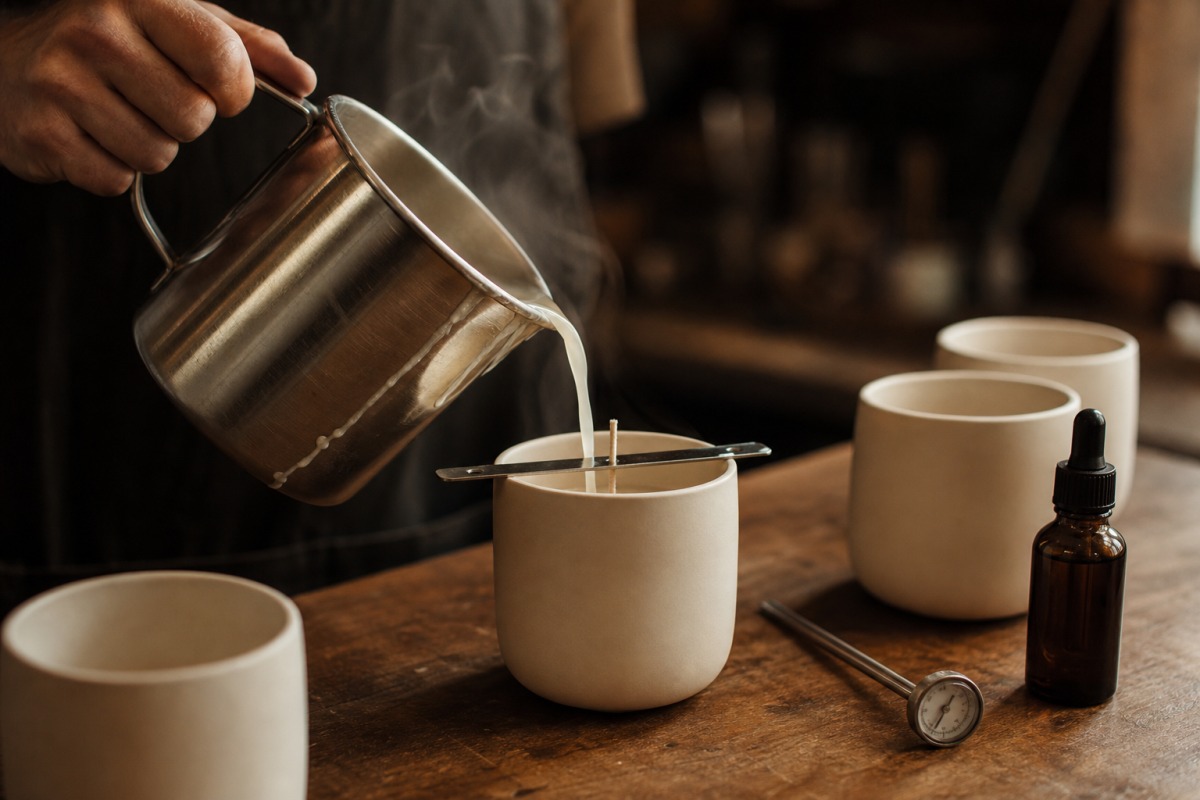
In studios where handmade candles are made according to IFRA, the process looks like this: vegetable wax is heated to 80 °C, fragrance oil is added at 65 °C (when it has not yet lost its aromatic molecules), the mixture is stirred for 3 to 5 minutes and poured into containers with an attached wick (standardly CD-12 or ECO-10 for a container 7 to 9 cm in diameter). Before the first sale, it undergoes a cure-time (maturation) of 7 to 14 days, during which the fragrance molecules are evenly distributed within the wax structure.
A candle with a 200 g wax batch contains 20 g of fragrance component at a 10 percent dosage. This amount diffuses evenly throughout the entire volume and provides a scent that does not change between the first and last burn. A dried flower on the surface, on the other hand, releases fragrance only upon direct contact with heat, which lasts for the first 30 to 60 minutes, then stops.
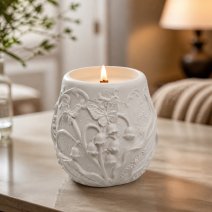
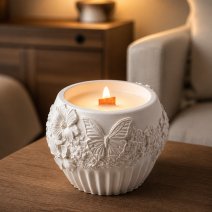
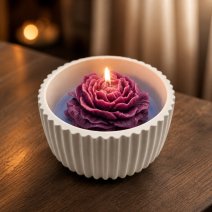
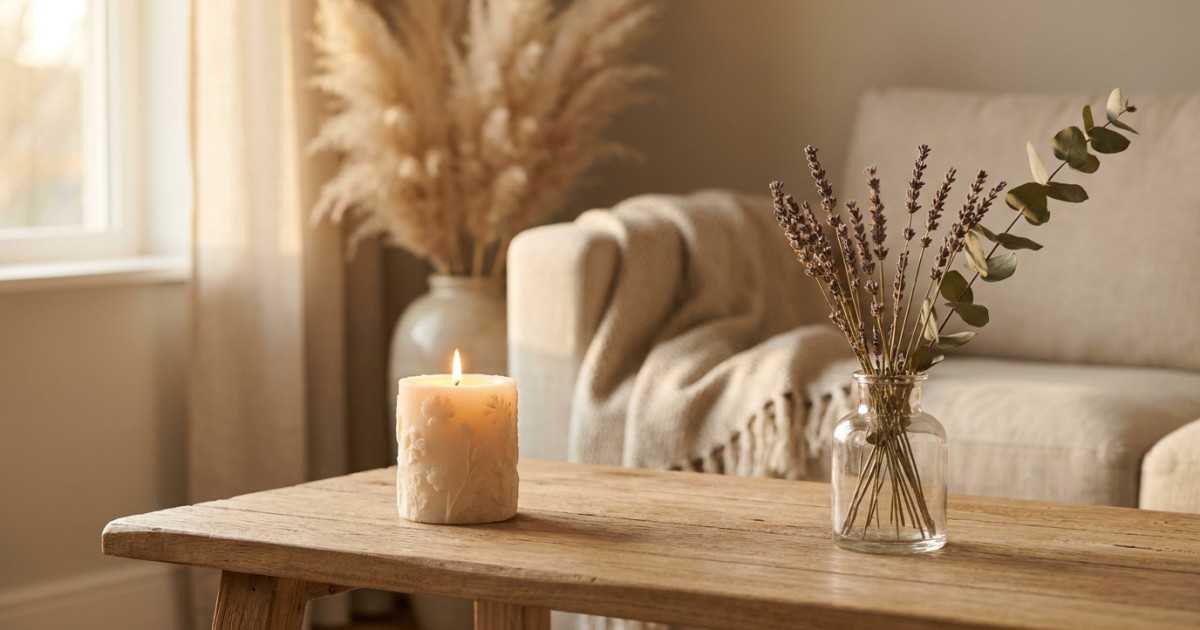
Visually, the botanical impression can be replaced in two ways. The first is a container with a relief or engraved botanical texture on the outside. The second is a candle with an embed (sealed decorative elements in a transparent paraffin layer on the outer circumference), where the decoration never comes into contact with the flame. In catalogs, look for the term "embedded decoration" or "decorative shell". The beauty remains, the risk drops to zero.
Decision tree and shopping checklist
If this idea makes sense to you, but you still want a visual floral moment in the living room, you have four paths. And when you are choosing a specific candle in a store or online, go through the 6 points below.
Four paths to floral aesthetics without a flower in the flame
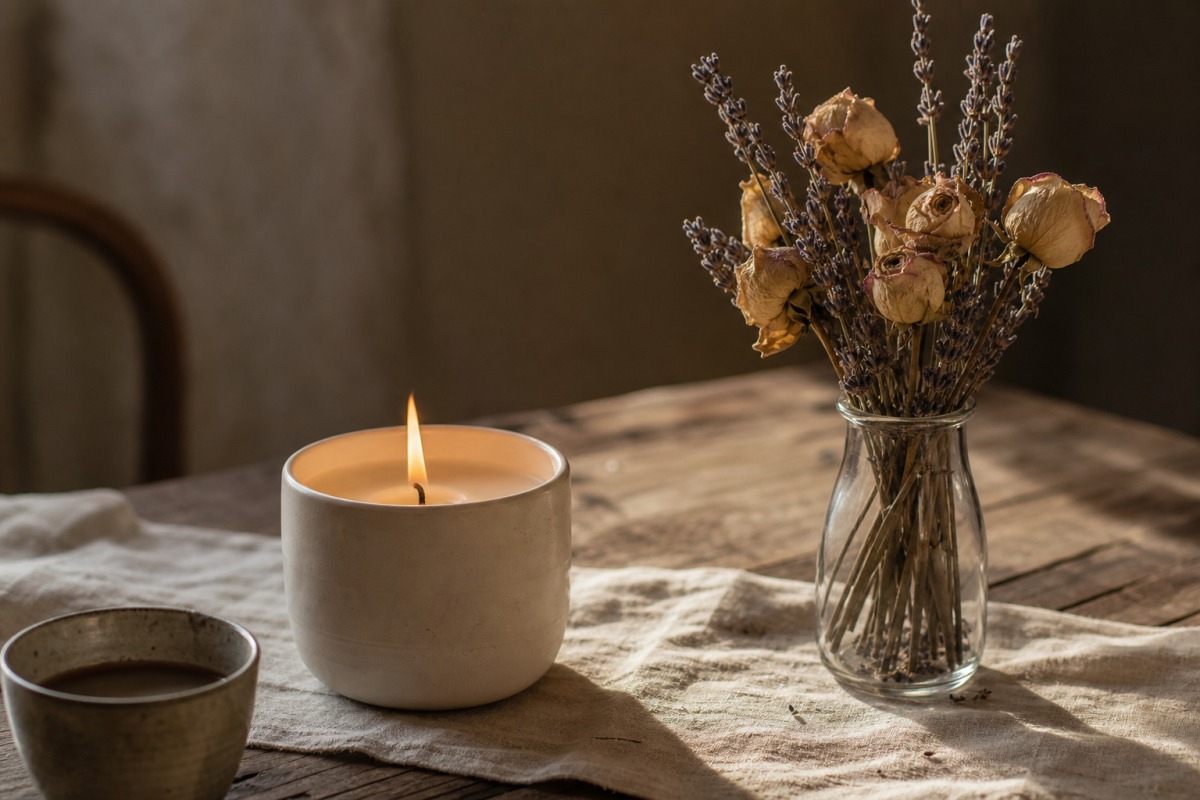
Path one, the most natural: A pure candle with a floral scent placed in a ceramic container, next to a small vase with dried flowers separately from the candle. The visual association is the same (candle plus flowers in one composition), but physically they are two distinct objects. The dried flowers in the vase do not touch the flame, the candle burns cleanly. Safety 100 percent. This is the only path that fully preserves the original Pinterest moment while eliminating the physical risk.
Path two, for decoration: A decorative "wax object" with embedded flowers, which is never lit. It functions as a visual ornament on a shelf or in a display cabinet. Upon purchase, it should have a clear label "display only" or "not for burning". However, many Etsy shops sell these candles without this declaration, and buyers do not realize the product is not designed for use.
Path three, a compromise: A candle with flowers embedded only in the top decorative layer, which you physically remove with tweezers before the first lighting. A compromise used in some boutique workshops. In practice, 70 percent of people do not read the instruction "remove decoration before lighting" and light the candle with it. The risk remains.
Path four, for creative types: Premium DIY. Make your own candle at home with wax certified for candlemaking, add fragrance oil at a dosage of 8 to 10 percent by weight, use a CD-12 or ECO-10 wick. No botanicals in the wax. The aesthetic is in the container and the label, not in the flame.
Six-point checklist when purchasing
First: Wax. Look for vegetable wax (soy, rapeseed, coconut, or a blend). Avoid undeclared paraffin or cheap gel (often sold as "transparent candle" with embedded flowers; gel burns differently than wax). The label "100% soy wax" or "vegetable wax blend" is trustworthy if the manufacturer is listed with an address.
Second: Fragrance oil. The label should include a reference to the IFRA standard or at least a specific fragrance profile (for example, "Bulgarian Rose 8% w/w" instead of "rose fragrance"). The percentage number is important because it indicates whether the manufacturer adhered to the maximum IFRA value.
Third: Wick. Cotton or cotton-paper is standard. Lead wicks have been off the market in Europe for a long time (manufacturers voluntarily phased them out in the 70s and 80s, several countries like Finland and Denmark banned them in 2001, and a federal ban has been in effect in the USA since 2003), but they occasionally appear in candles of unknown origin. Look for a "lead-free wick" certification.
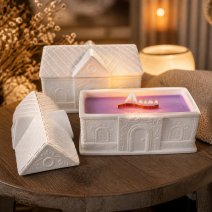
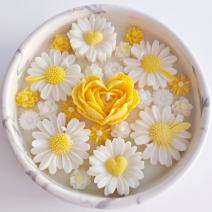
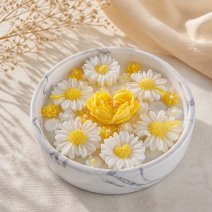
Fourth: No embedded flowers, herbs, or decorative elements in the wax body. The main criterion from this article. If a candle has a flower in the wax, it is not a candle, it is a wax sculpture for a photo.
Fifth: Container. Glass or ceramic with a wall at least 3 mm thick. Thin-walled cups can crack from thermal shock during advanced burning.
Sixth: Burning time and wax pool. A quality candle with 200 ml of wax has a declared burn time of 35 to 50 hours. The wax pool should reach the edge of the container within 2 hours, otherwise the wick mushrooms and a "tunnel" forms. If the manufacturer does not provide these numbers, it is a weak signal.
Conclusion: aesthetics is about separating layers
Decorative candles with botanicals are not a new idea. Older artisanal versions placed plant elements in an outer sealed layer, never in the burning center. The modern Pinterest trend from 2015 onwards abandoned this safety principle in favor of quick production and photogenic composition. The aesthetic of a dried flower directly on the wax means direct contact of flammable material with the flame, acrolein evaporation, wick submersion, and color drift.
Dried flowers, cinnamon, and citrus peels in candles are visually appealing, but physically incompatible with a flame. Acrolein from burning cellulose is an IARC 2A carcinogen upon repeated exposure. Cinnamaldehyde from cinnamon evaporates when heated, and its vapors can ignite violently upon contact with the flame. Dried lavender absorbs up to three times its weight in wax and drowns the wick. Plant tannins shift the wax color from off-white to brownish-yellow after three to four burns. According to NFPA data, candles in general account for approximately 3 percent of home fires, and a flammable additive placed directly in the path of the flame only increases this risk.
The Pinterest scene from the beginning of the article doesn't disappear, it just splits. A candle with a pure floral scent in ceramic, dried flowers in a glass vase next to it. Two things, one aesthetic. Safe, repeatable, long-lasting. If you're looking for a floral candle with a trustworthy profile (vegetable wax, fragrance oil within IFRA limits, no embedded botanical elements), check out handmade pieces from small craft workshops.
If a candle with a dried rose is burning in your kitchen right now, blow it out, remove the decorations with tweezers (after it has cooled), trim the wick to 5 mm, and get a clean alternative for it. The aesthetic goal is achieved through the chemistry of the scent, not through the physics of the plant. You win on both safety and appearance.

Mother of two daughters, wife of Roman and the heart of our creative studio. Besides writing blogs, she dedicates herself daily to the handmade production of candles and decorative containers — she knows the materials, knows what lasts and what simply delights the home. She looks at jewelry, watches and fashion accessories from real family practice: what serves, what endures and what truly brings joy.
All articles by author
 Container Candles
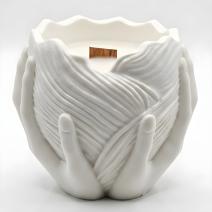
Candle Embrace - White / Cherry
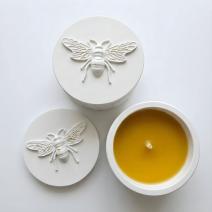
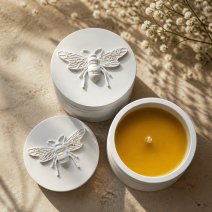
Bee Candle - White
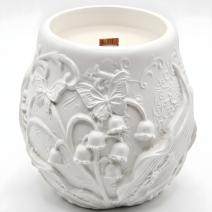
Convallaria Candle - White / Milk, Honey
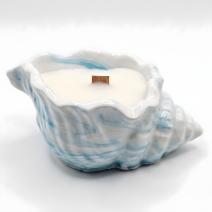
Candle Wave - Blue / Vanilla
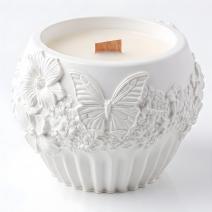
Candle Meadow - White / Cherry, Almond
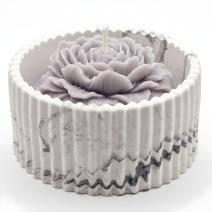
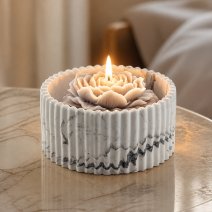
Carrara Candle - Peony / White / Silver / Lime, Mango
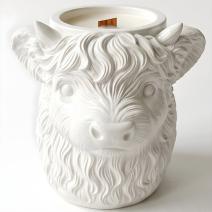
Highland Cow Candle - White / Vanilla
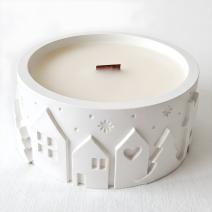
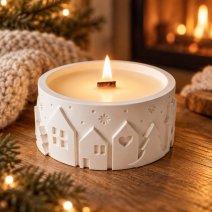
Winter Landscape Candle - White / Milk, Honey
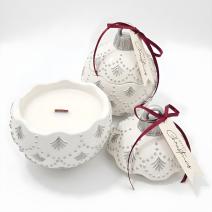
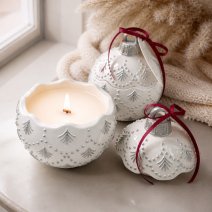
Christmas Bauble Enchanted Candle - White / Silver / Winter Magic



Comments
Add comment
Login required
To add a comment, you must log in to your account.
Don't have an account? Register