
Hidden message in wax: why paper does not belong to the flame
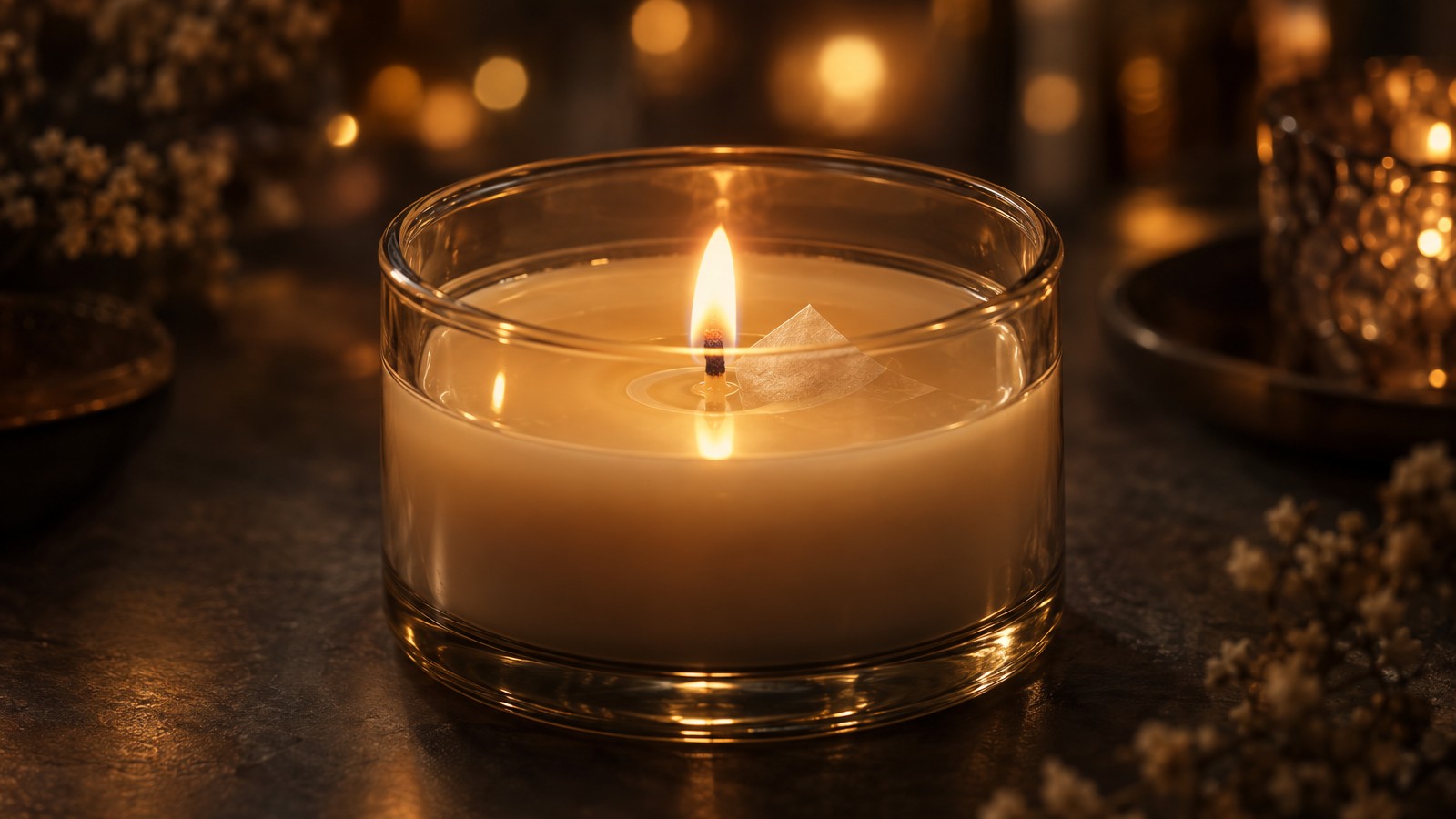
The video had millions of views and looked exactly like the gift with the promise of a personal touch that one imagines. Melted soy wax is poured into a glass container. In the middle, right next to the wick, a floating piece of tracing paper with the message "Open me in a year" written on it. The wax soaks through, stays in place, beautifully waiting beneath the surface. The instructions look simple, and in the comments, hundreds of people swore they would try it. Jana — for this article, a model character into whom we summarized the typical course of such an incident — was pouring the last piece on Tuesday evening. At around 233 degrees Celsius, which Ray Bradbury made famous with the title Fahrenheit 451, the cellulose fiber stops behaving like paper and starts behaving like fuel. It was this very threshold that, a few weeks later, led her to a photo of a burnt table and the smell of a smoke cloud that lingered in her curtains.
The Physics of Cellulose: Why 233 °C Determines Everything Else
Cellulose is a polymer with a repeating glucose unit, and in its pure form, it makes up 90 to 99 percent of paper fiber. When heated, it goes through three phases. Up to 150 degrees Celsius, it releases moisture and becomes brittle. Between 150 and 200 degrees, the molecular chains begin to break, and the fiber turns brown, a process known as pyrolysis. At 233 degrees, it reaches the autoignition point: the temperature at which flammable gases (carbon monoxide, methane, formaldehyde) produced by decomposition reach a concentration that ignites spontaneously, even without direct contact with a flame. Heat alone is enough.
Ray Bradbury published the novel Fahrenheit 451 in 1953, and the title became a cultural symbol. 451 degrees Fahrenheit corresponds to approximately 233 degrees Celsius, and Bradbury claimed it was the temperature at which paper ignites. Scientifically, this is not entirely accurate, as the flash point of paper depends on its weight, moisture, surface treatment, and the presence of oxygen. As a general reference, the value of 230 to 235 degrees holds consistently under laboratory conditions. For tracing paper with a glycerol coating, the lower limit is already around 218 degrees.
The flame of a paraffin candle has three zones. The inner dark cone near the wick contains unoxidized fuel vapors and has a temperature of 600 to 1,000 degrees Celsius. The middle yellow zone, which gives the candle its characteristic color, reaches 1,000 to 1,200 degrees; the yellow hue comes from the incandescence of glowing carbon particles. The outer bluish edge of the flame, where oxygen fully meets the fuel and combustion is complete, reaches up to 1,400 degrees Celsius. The air around the flame, up to a distance of 2 centimeters, still has 200 to 300 degrees, a temperature exceeding the autoignition point of paper. In other words: paper does not need to be in the flame to burn. It just needs to be close enough.
Melted paraffin acts as an accelerator. Paraffin melts at 60 to 70 degrees, and at 200 degrees, it begins to boil and release paraffin vapor. If a piece of paper touches the liquid wax and the wax wicks into the fiber through capillary action (the paper absorbs the wax like a wick ribbon), the paper becomes a secondary wick. At that moment, the same mechanism that keeps the wick in the flame transfers the burning to the paper as well. The flame, which was supposed to be 1.5 centimeters high, suddenly transforms into an open 5 to 8 centimeter flame fueled by cellulose.
Four Materials, Four Flash Points, Four Pyrolytic Products
In posts with instructions for making "love note" candles, four types of materials are most commonly mentioned: regular office paper, tracing paper, baking parchment (silicone-coated paper), and thin plastic films made of PE or PET. Each ignites at a different temperature and releases different chemical products during decomposition. The table below summarizes the approximate order of flammability and typical combustion products — these are not precise laboratory values for a specific product, but a general comparison of why none of these materials belong in a flame.
| Material | Grammage | Approximate Ignition Temperature | Main Combustion Products |
|---|---|---|---|
| Office Paper | ~80 g/m² | ~230 °C | CO, CO₂, formaldehyde, acetaldehyde |
| Tracing Paper | ~70 g/m² | ~220 °C | CO, CO₂, formaldehyde, glycerol vapors |
| Baking Parchment (Silicone) | ~40 g/m² | ~250 °C | Cyclic siloxanes (D4, D5), CO, formaldehyde |
| PE / PET Thin Film | ~12 – 30 g/m² | Higher than paper (on the order of hundreds of °C) | Acrolein, formaldehyde, and other irritants |
Values are indicative — they serve to compare the order of flammability, not as precise laboratory figures for a specific product. The actual ignition temperature depends on grammage, moisture, surface finish, and oxygen supply. The common conclusion: paper ignites most easily, plastic later, but with worse combustion products.
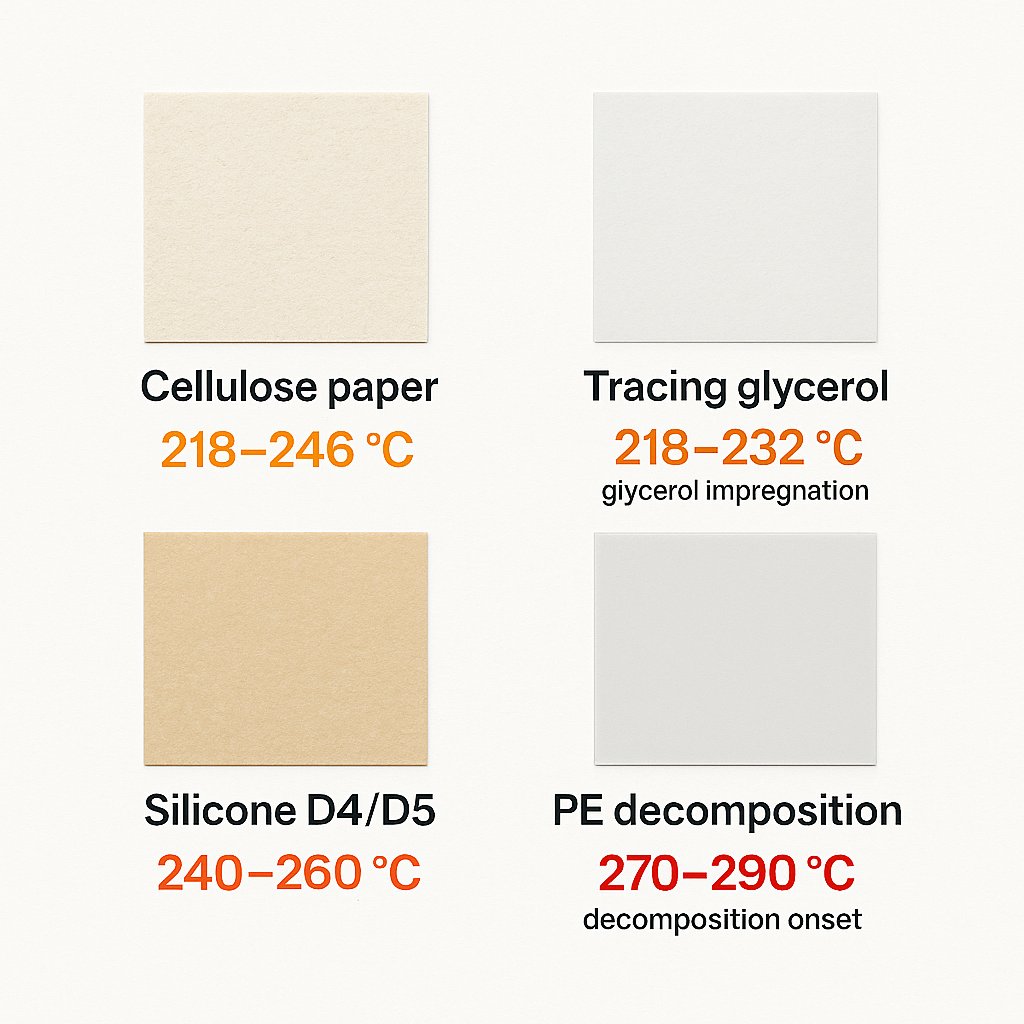
Office paper: 218 degrees, the lowest barrier
Standard office paper is mostly cellulose, with fillers (such as kaolin for printing), starch, and optical brighteners. Those brighteners are stilbene derivatives that release irritating aromatic aldehydes when burned. The paper starts to noticeably brown a little before it fully ignites — with love-note candles, it's more important that once it soaks up wax (60 to 70 °C), it soon behaves like a second wick: the wax wicks into the fiber and the paper sustains the flame. From that point on, it burns independently.
Tracing paper: glycerol impregnation changes behavior
Tracing paper is made by calendering — mechanically compressing cellulose fibers, not through chemical treatment. Some formulations add a little glycerol as a plasticizer to keep the paper flexible. And it is precisely the glycerol that makes tracing paper behave more unpleasantly in wax than regular paper: when burned, it releases acrolein, a pungent aldehyde that irritates mucous membranes even in small concentrations. This is why burned tracing paper doesn't smell "papery," but sharply and penetratingly.
Baking parchment: siloxanes above 250 degrees
Baking paper (parchment) has a non-stick silicone layer on a cellulose core. When heated, the silicone begins to release cyclic siloxanes, particularly D4 (octamethylcyclotetrasiloxane) and D5 (decamethylcyclopentasiloxane). D4 and D5 are classified in the EU as persistent, bioaccumulative, and toxic substances (PBT and vPvB respectively) and are gradually being restricted — the original restriction under REACH (Regulation 2018/35, Annex XVII, Entry 70) however applied to washable cosmetic products, not candles or parchment. When parchment is burned, these siloxanes may be released into the air only in small amounts, which is not acutely dangerous, but it is another reason why kitchen materials do not belong in a decorative candle.
Plastic films: decomposition onset at 280 degrees and acrylate monomers
Thin films of polyethylene (PE) or polyethylene terephthalate (PET) are used in handmade candles to protect the paper from sticking to the wax. PE decomposes during thermal breakdown into acrolein, formaldehyde, and short hydrocarbons. PET is somewhat more stable and ignites at a higher temperature, but its decomposition produces irritating and potentially harmful organic substances. Plastic in wax offers no thermodynamic advantage: it burns, just a little later and with products that are toxicologically worse than the combustion products of paper alone.





Why Pinterest tutorials stay silent about thermophysics
The question that almost always comes up with this topic: why doesn't Pinterest inform about this risk? The platform does not distinguish a DIY tutorial from a safety guide, and the content creator has no obligation to state the physical limits of an idea. That's just the beginning of the answer; the more interesting part lies in how the hidden-message candle evolved.
Hidden-message candles originated as merchandise products of small craft businesses around 2018. The original versions had the paper embedded in the lower third of the wax (below the level the flame could reach) and often came with an explicit instruction "never burn down to within 1 cm of the paper." In professional production, the paper is poured so that during normal burning, the candle extinguishes itself before revealing the message. The message then only comes to light when the candle has completely solidified and the person breaks it apart or carefully disassembles it.
Amateur replicas mostly omit this safety detail. Instead of the lower third, they show the paper placed in the middle or upper part of the wax, because "otherwise it wouldn't be visible while burning" — and it is precisely the floating message beneath the surface of the melted wax while the flame burns that looks captivating in a video. The reality of fire physics at that moment is completely different from the aesthetics of the video.
The second reason for the silence about risks is distributed responsibility. The hobby store sells wax pellets, the hobby store sells tracing paper, the hobby store sells wicks. None of these products is dangerous on its own. The combination born in the user's mind is not the content of any instruction on the packaging. Only when a person puts three components together in a configuration that is nowhere formally recommended does a risk arise that cannot be attributed to any single supplier.
47 seconds: anatomy of one incident
Jana is a music editor, 31 years old, she likes to make gifts by hand. For her partner's birthday, she prepared three candles with handwritten messages on tracing paper. She watched the Pinterest tutorial twice, bought the material at the hobby store, ordered the wicks online. On Tuesday evening, she poured the last piece, then went to sleep. The candle stood on a wooden table in the living room. The message inside was on 70-gram tracing paper, placed approximately 2 cm from the wick, because "it should be readable through the glass and the wax is quite clear."
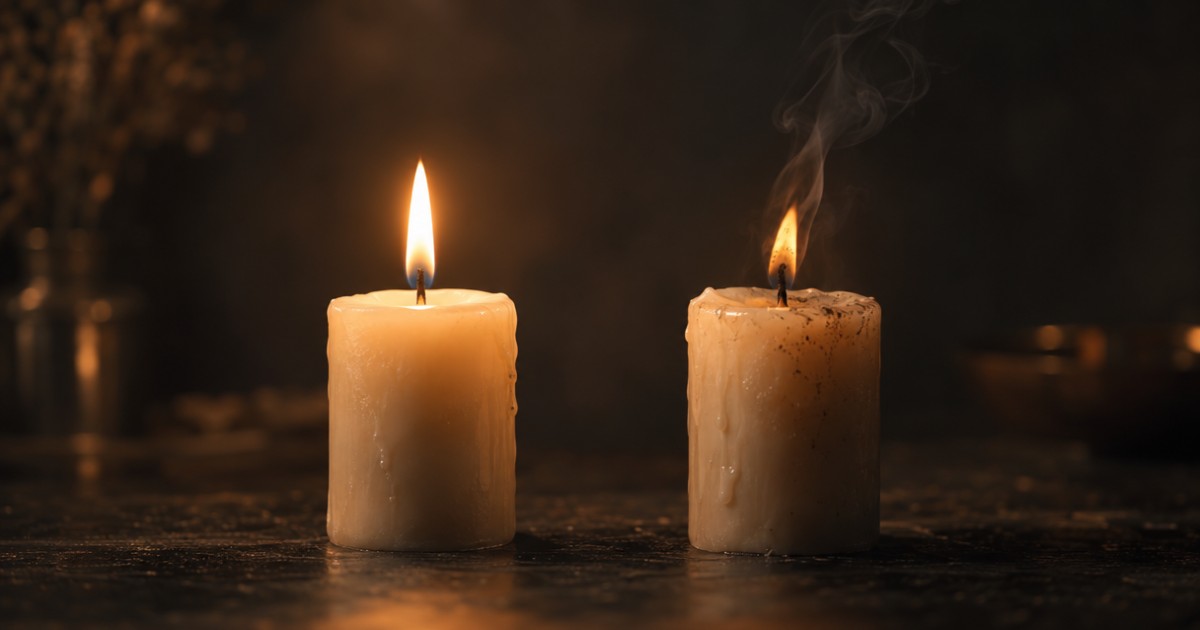
Two weeks after production, on Wednesday evening at 10:10 PM, she lit the candle. The flame burned calmly for 11 minutes, just like any other candle. In the 12th minute, the level of melted wax dropped enough that the top edge of the paper rose above the surface. The paper, previously saturated with wax by 80%, suddenly had a dry edge. The contact zone with the flame was 8 mm. The flame's glow in the wick zone is 600 to 800 degrees Celsius; paper cellulose has a flash point of 233 degrees. The top edge of the paper ignited, the flame shot up 6 cm higher, caught the decorative shading flower on the edge of the container, which ignited the polyester ribbon, the polyester ribbon burned onto the wooden tabletop and scorched it to a depth of 3 mm. The entire sequence from the moment "the paper rose above the surface" lasted 47 seconds.
Jana's movement was quick, the fire blanket was in the kitchen, and the fire damage remained localized. The table is unusable, the curtains remained saturated with smoke, and the living room smelled of burnt parchment for a month. The smell resembled a mixture of campfire smoke, a sharper perfume, and something best described as "an old church after candles." This odor has its own chemistry, which we will get to below.
The main error in risk assessment is the assumption that the worst-case scenario is "paper burning in wax." In reality, the paper is only the first link in a chain. The flame that shoots above the candle's surface is 8 to 15 cm high instead of the usual 2 to 3 cm. The thermal energy of such a flame is sufficient to ignite dried flowers or decorations at the edge of the container, polyester ribbons above the candle, the wooden board under the candle, or curtains within a 30 cm range. In Jana's case, three out of four links in this chain were realized. It is precisely this chain effect that turns a minor pyrotechnic error (paper rising above the surface) into a potential for a moderately serious fire.
Inkjet inks by pyrolysis: formaldehyde and acrolein
Risk analysis often overlooks that the paper used in a "love note" candle is not pure cellulose. It is printed with text, either by hand with a pen or from an inkjet printer. Inks are emulsions containing 70 to 85 percent water, 5 to 15 percent dye (pigment or soluble dye), and 5 to 20 percent solvents and stabilizers.
Inkjet inks from common consumer printers contain a mixture of glycol ethers, most often 2-pyrrolidone, glycerol, and ethylene glycol. These substances have flash points ranging from 90 to 199 degrees, meaning they do not release significantly upon contact with wax temperatures of 60 to 70 degrees, but during paper pyrolysis (above 200 °C), they contribute to the toxic spectrum of combustion products. Formaldehyde (HCHO) is classified by the World Health Organization as a Group 1 carcinogen (IARC, 2006). Acrolein (CH₂=CHCHO) has an IDLH (Immediately Dangerous to Life and Health) limit of 2 ppm.
Burning a small inkjet-printed "love note" slip (typically around 5 × 5 cm) does not release a huge amount of pollutants, but it adds precisely those substances to the air that are toxicologically problematic — both formaldehyde and acrolein. In a normally ventilated room, concentrations remain well below the acutely dangerous threshold; the problem is not acute poisoning from a single burning event, but that these are substances for which health authorities (including the WHO) recommend minimizing even long-term, repeated exposure. Moreover, the burning paper and ink do not contribute to the aldehyde load in the room on their own — they add to the combustion products of the wax itself, so the total air load is higher than with a clean candle. For a romantic gift, this is an unnecessary risk that can be easily avoided.
A hand-written message with a pen has a different profile. Gel ink pens contain 30 percent solvent (usually benzyl alcohol, flash point 93 °C) and during pyrolysis release trace amounts of toluene and xylene. Classic fountain pen ink is less problematic (iron-gall dyes), but it also contains 5 to 8 percent phenol as a preservative.
What statistics say about candle fires
The National Fire Protection Association (NFPA) in the USA aggregates reports from local fire stations into reports on home fires. According to published data (NFPA, analysis by Marty Ahrens for the period 2009–2013), US firefighters responded to an average of about 9,300 home fires per year where a candle was the ignition source — roughly 3 percent of all home fires. These fires resulted in an average of about 86 deaths, 827 injuries, and approximately 374 million dollars in direct property damage annually. Considering how many candles are sold in the USA each year, this is a statistically small but absolutely non-trivial threat.
The most common cause of these fires is a candle left unattended. Right behind that is a combustible item left too close to the flame — and paper decorations, decorative ribbons, and in recent years, hand-written messages in wax fall precisely into this category.
The US Consumer Product Safety Commission (CPSC) collects injury data through the NEISS (National Electronic Injury Surveillance System), which draws from hospital emergency departments. However, NEISS codes injuries according to a fixed list of product categories (e.g., "candle"), not by a specific instruction or variant like "hidden message candle" — therefore, it is impossible to extract the exact number of injuries caused specifically by a candle with an inserted message. What is unequivocally clear from basic physics and reports on candle fires is the direction of the risk: inserting a flammable object (paper, plastic film) directly near the flame creates a real possibility of burns to hands and forearms, smoke inhalation, and especially the spread of the flame to surrounding textiles — curtains, decorations, upholstery. This risk is not hypothetical; it just hasn't yet been captured as a separate statistical category.
In the EU, there is no similar centralized statistic specifically for "love note" candles publicly available, so no specific number of cases can be responsibly stated. However, by its very nature, the risk grows with the popularity of DIY candle content on social media — especially Pinterest tutorials, which have generated millions of views for the same technique since 2021. The more people try the combination of paper and flame, the more likely it is that some attempts will end in fire.
EN 15426 and NCA recommendations: what the standard says about foreign objects
For the buyer, one technical detail is important: the fire safety of candles intended for indoor burning is addressed by the European standard EN 15493 (Candles — Specification for fire safety). It focuses on ensuring the candle burns stably, controllably, and self-extinguishes if necessary — meaning flame stability, container integrity, and self-extinguishing behavior. The standard thus assumes a product to which no one adds foreign objects; the "paper in wax" scenario falls entirely outside its scope. (For completeness: the related standard EN 15426 concerns soot formation and combustion quality, not fire safety.)
Another standard, EN 15494 (Candles — Product safety labels), prescribes which safety pictograms and warnings must be on the packaging. They cover things like "do not leave burning unattended", "keep out of reach of children", "do not place near flammable objects", and "place on a stable, non-flammable surface". However, none of these pictograms say "do not insert paper into the wax" — the standard assumes the buyer will not disassemble and modify the finished candle.
Recommendations from candle manufacturers and professional associations agree on one thing: a candle should contain nothing but wax, a wick, and possibly color or fragrance — no dried flowers, decorative beads, wires, and certainly no paper. This rule applies to both commercial candles and home production. Tutorials on social media rarely consider it.
Compliance with these standards is overseen by market inspections (in Slovakia, the Slovak Trade Inspection). Small sellers of handmade candles via social media often do not rely on them at all. Before buying a "custom" candle on Etsy or Instagram, it is therefore wise to ask the seller if there is anything extra in the wax and how they constructed the candle. If the answer is "it doesn't matter, the wax will cool it down", you have a very concrete reason to look for another workshop.
A safe version of a romantic gift
From a technical perspective, the conclusion is simple. A candle has one job (to burn controllably), a paper note has another job (to preserve text). Combining them into one object means each of these tasks threatens the other: the candle stops burning controllably (increases the flame), the paper stops preserving text (burns up). The solution is simple: separate them.
The main change worth considering is separating the message from the flame. The candle can remain a romantic part of the gift, but the note does not have to be inside it. This shift has three practical advantages that go far beyond safety. First, the note on a separate card can be read in peace. With a candle containing floating paper, a person guesses words through the wax and glass, sometimes cannot see them entirely, and sometimes completely loses orientation when turning the candle. A card with handwritten text is readable immediately and in a size unrelated to the container's size. Second, the card can be preserved. A candle has a functional lifespan of 30 to 60 hours of burning, after which only an empty glass container remains and a feeling that the gift "has been used up". A card placed in a book, a drawer, or a frame will remain physically present for decades. Third, the card can contain a long text. Pinterest versions of notes have a maximum of 4 to 6 words for obvious reasons ("I love you", "you are my home"). A card allows writing an entire paragraph, a personal story, or a longer poem.
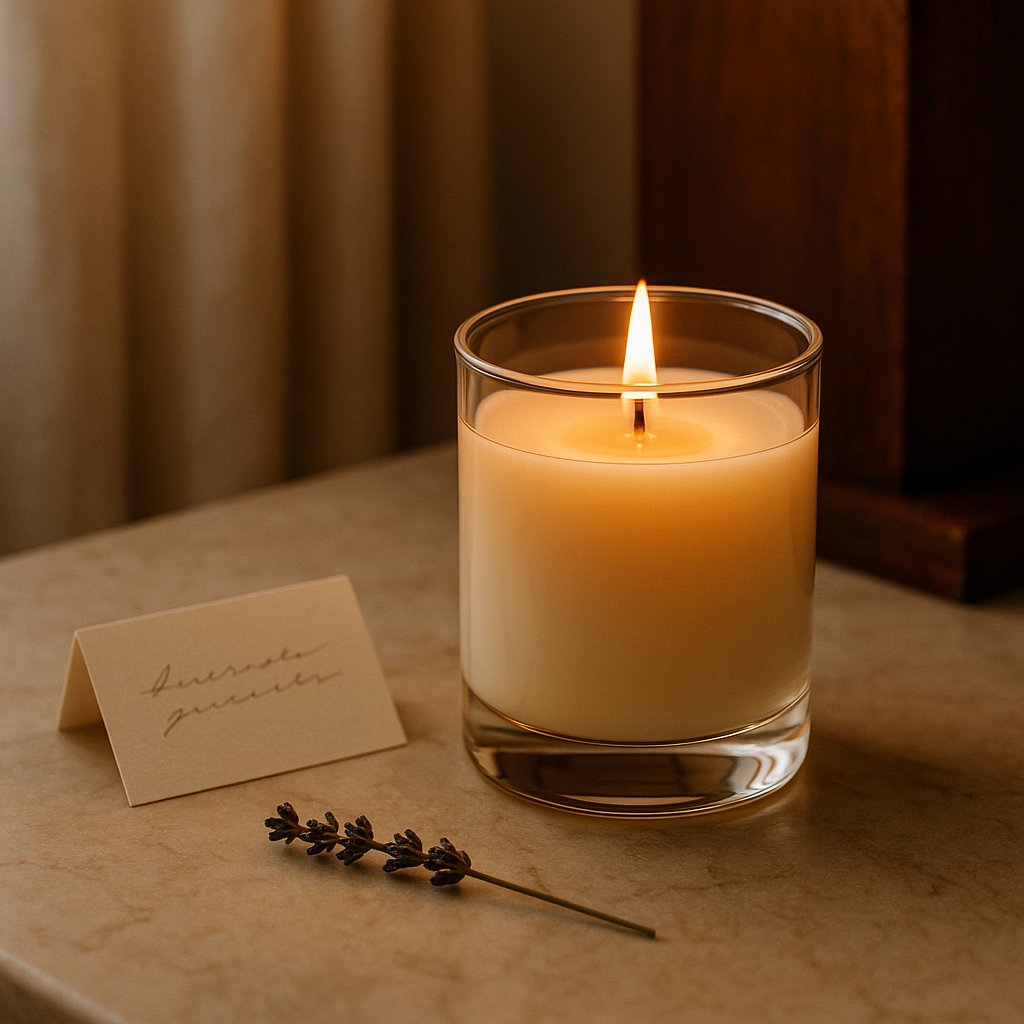
The safe version of a gift composition consists of three components. First, the candle. Preferably soy wax in a borosilicate glass container or ceramic with a temperature resistance above 200 °C. A wooden or cotton wick with a minimum distance of 5 mm from the wall. Second, the card with the message. Classic 250 g/m² cardboard (not inkjet printed, but handwritten or laser printed, with drier toner than ink) placed 30 cm away from the flame. Third, a base. A fireproof mat or ceramic plate under the candle to prevent heat transfer to wooden furniture.
Fragrances in premium candles should be declared either as essential oils (with the specific botanical name of the plant in the composition) or as fragrance oils referencing the IFRA standard. Borosilicate glass withstands a thermal shock of 165 degrees without cracking and, after burning out, can be used as a cup or storage item. Soy wax burns cleaner than paraffin, the smoke is lighter, and soot on the ceiling is minimal. A wick without a lead or zinc core is today's standard among honest manufacturers.



Three rules and a return to Jane one year after the incident
Hidden-message candles are one specific example of a broader phenomenon: the category of "instagrammable candles" also includes other risky configurations. Candles with dried flowers in the wax, candles with small metal items, candles with crystals or semi-precious stones embedded near the wick. They all share a common core: aesthetics win over physics. The three rules worth keeping in mind before any purchase or production of a candle are as follows.
1. There should be nothing in the wax except wax, a wick, and possibly color/fragrance. This is the wording of the NCA directive, but it can be translated into a practical sentence: if you see something in a candle that wouldn't have been in a paraffin candle in the 19th century, there should be a reason for it not to be there. Dried flowers, leaves, pearls, wires, paper, polymer decorations. All are materials that, during pyrolysis, add components to the smoke that don't belong there, and which, in certain combinations, trigger an ignition cascade. The exception is materials that are embedded in the wax purely for aesthetics and are placed in zones where the flame cannot reach during normal burning, typically in the bottom third of the candle in large containers.
2. Although the flame burns in a 600-degree zone, it affects the space up to 30 cm around it. The table on which the candle burns should be non-flammable or at least protected by a mat made of ceramic, metal, or heat-resistant glass. A wooden table without a mat can withstand regular candle burning for 5 to 10 years, but it cannot handle an incident where the flame extends beyond the container. Furniture around the candle, including curtains, shelf decorations, and textile ornaments, should be at least 30 cm away. Real fire hazards usually don't affect the table itself, but an adjacent interior element.
3. A candle burning unattended is a candle that can burn down into an unpredictable phase. This is the most overlooked rule, because adopting the principle "don't light a candle if you're leaving the room in 30 minutes" fails in real life. A compromise is to set an alarm or use candles in borosilicate containers with automatic self-extinguishing: the wick is trimmed short, so the candle burns in 6-hour intervals and extinguishes itself before the wax level reaches the bottom. These candles exist and are worth seeking out when purchasing, especially for homes with small children or pets.
In our model scenario, the insurance company would only cover part of the damage to the table, and the curtains would remain the household's responsibility — and this is exactly how such accidents usually end. When looking back for the cause, it is almost never a single thing; it is a chain of missing safeguards. The wax was standard soy (fine), the wick was cotton (fine), the container was average glass (fine for normal burning), the wooden table had no mat (risky, but acceptable in a normal situation), the paper was placed in the top third of the wax (critical). If the paper had been in the bottom third, the candle would have burned out before being exposed. If there had been a ceramic mat under the candle, the damage to the tabletop would have been minimal. Each one of these "ifs" costs just a few euros. The real damage — ruined furniture, cleaned textiles, and weeks of unrest — is often many times higher.
Hidden-message candles won't disappear. Pinterest tutorials will continue to be published, with millions more views and more enthusiastic DIY-ers. This text does not aim to ban the trend or scare people. It only seeks to separate aesthetics from physics and leave room for informed decisions. A romantic gift can be wrapped as a combination of an elegant candle and a card placed next to it. The scents remain. The flame remains. The feeling of intimacy remains. The only thing that disappears from the concept is paper within 8 mm of the flame.
A year later, the partner received a candle in a borosilicate container, soy-based, with a scent of bergamot and cedar, and next to it a handwritten card wrapped in a linen napkin. The candle burned for three evenings; he kept the card in a book he opens in the morning. The table is new, the curtains replaced. The living room no longer smells like a church; it smells of wax.

Mother of two daughters, wife of Roman and the heart of our creative studio. Besides writing blogs, she dedicates herself daily to the handmade production of candles and decorative containers — she knows the materials, knows what lasts and what simply delights the home. She looks at jewelry, watches and fashion accessories from real family practice: what serves, what endures and what truly brings joy.
All articles by author
 Container Candles

Bee Candle - White
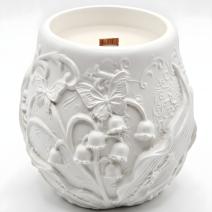
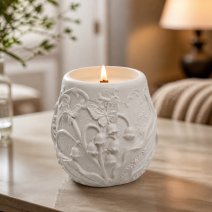
Convallaria Candle - White / Milk, Honey
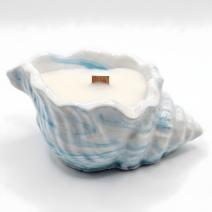
Candle Wave - Blue / Vanilla
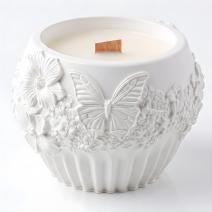
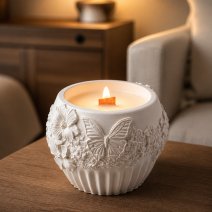
Candle Meadow - White / Cherry, Almond
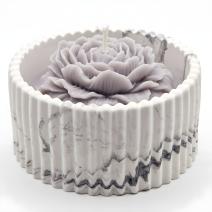
Carrara Candle - Peony / White / Silver / Lime, Mango
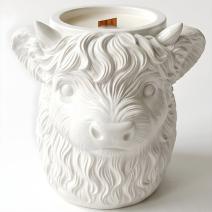
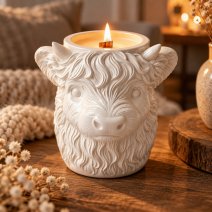
Highland Cow Candle - White / Vanilla
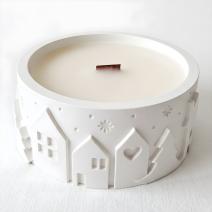
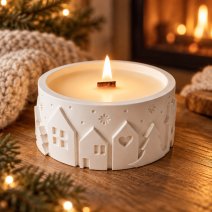
Winter Landscape Candle - White / Milk, Honey
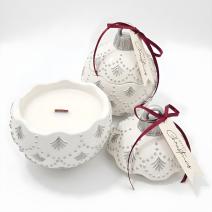
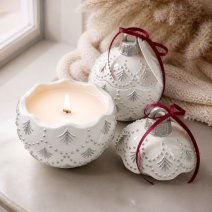
Christmas Bauble Enchanted Candle - White / Silver / Winter Magic
Medium House Candle - White / Apple, Cinnamon





Comments
Add comment
Login required
To add a comment, you must log in to your account.
Don't have an account? Register